Thursday, February 7, 2013

FELTED BEADS

Carolyn taught me how to make long felted beads (which can be cut into shorter beads).  The tools are simple:  four wooden pencils (the kind that have six sides), rubber bands, a rattan place mat, hot soapy water (Ivory dish soap), and merino wool roving.  This long bead was embellished with shiny threads and seed beads, then strung onto a necklace made of twisted yarn cording.  Easy.  (You can make all the photos larger by right clicking on the photo and opening it in a new window.)


Please note:  Carolyn checked my instructions, and here are her notes on the process, involving the temperature of the water.  Although I like to use very hot water (as in my instructions) it is important, when working with children, that the water should not be extra hot.  "Hi there, good directions and pics! I only have one thing to add -- you really do not need to use very hot water. I start with hot water (not too hot for your hands) and put it in bowls on the tables when I teach this, and the water gets pretty luke-warm and then cold, and still works. It's probably better to replace it with more hot, but it really doesn't need to be very hot." 

For this bead, below, I chose rovings in colors to match some beads & fibers I had on hand.

A white (filler) roving was used first.  Spread it thin and wind it around the four pencils, which are held together at each end with rubber bands.  (Please note:  I am holding down the roving with the container of spoons to show how to stretch it out thinly.  I had the camera in my other hand!  You don't need to use any weighted objects in this project.  I almost dropped my camera in the sink at one point!)

Wind the roving back & forth, from side to side a couple times.

Until it is about this thick:

Next the main color of roving is used.

Wind it back & forth, from side to side, a couple times.  Keep the roving off the rubber bands!  If you don't, you won't be able to get those pencils out later.  (If you want to make a shorter bead, bring the rubber bands in.

Contrasting, thin pieces of roving are wound around for decoration.

Back & forth, from side to side, but always winding in the same direction.  (I go over the top and behind.)

Get your water quite hot (as hot as you can comfortably stand; rubber gloves are a must for children - or simply make it extra warm as per Carolyn above).  It should also be really soapy.

Dip in the hot, soapy water, and squeeze out the water, several times.  Roll lightly on mat in forward direction only. (If you roll up and down at this point, the fibers will want to unwind off the roll.)

Please understand that your finished bead will not look exactly like the contrasting fibers you laid down so carefully.  That's the fun part of felt bead making!  Roll it lightly to keep the fibers intact as much as possible.

Re-dip in the hot, soapy water (add drops of soap directly on the bead if necessary) and squeeze out the soapy water.  Lightly roll.  Do this several times, checking it, re-dipping, squeezing, and rolling lightly on top of the mat. 

When you can see that it is starting to felt, you can roll harder, on top of or inside the rattan place mat, back and forth, roll roll roll!

When it starts to really felt and shrink, take the rubber bands off and remove one of the pencils.

Re-dip, add drops of soap directly if necessary, squeeze out excess.

Roll hard, re-dip, squeeze, roll some more.  Repeat.  Take out another pencil, re-dip, squeeze, roll hard!

Repeat this process of re-dipping, squeezing, and rolling hard, until you are down to one pencil and the felted roving is very tight around the last pencil.  See how soapy my hand is?  Lot's of soap was used!

Here is the bead on the last pencil.  When fully felted, rinse it very well in hot water, to get all the soap out.

Remove excess water with towel.

Remove pencil, and thread yarn through the bead with a bodkin.

Tie bead around a mason jar or other round object that suits the shape you want your bead to take.

Put in sunny spot to dry thoroughly.

A few days later I made more beads.  This time after the fourth pencil was removed, I inserted plastic tubing from the hardware store, a little smaller than the pencil diameter.  I continued to felt it and let the felt dry over the tubing.  I then cut the long bead into four shorter beads.  The plastic tubing gives the beads a firmness, and your yarn can be threaded through the tubing.  (See picture above, under Fiber Camp post)

NEXT -- a Felted Headband and Round Beads


Felted Headband

I thought I would give a felted headband a try, but didn't think it would work.  You can't agitate it by rolling back & forth in the rattan placemat.  Here I used a fabric covered plastic headband (a package of five found in the Dollar Store).

I covered the band in the same way the pencils were covered, starting with white roving as a filler, which I  wrapped back & forth two times.

I then covered the band with the main color of roving (pink), then the accent colors in thin strips, then more of the pink in thin strips.

The wrapped headband was dipped in very hot, very soapy water, then squeezed out all along the headband.  I repeated this step several times, adding additional drops of the liquid soap to make it very sudsy.   

Occasionally I would rinse the band in very hot water, to shock it into felting. 

When the felting started, I got more agressive with the band.  Lots of hot water and soap directly on the band, making it slippery enough to slide the finger tips back & forth on the outside and inside of the band.  This seemed to provide enough agitation to continue the felting process.  I repeated this step several times,  sometimes rinsing the soap out with hot water in between.  As you can see from the photo, it actually felted! 

When it was fully felted, rinse in hot water, pat dry with a towel.....

And put in the sun to dry.  A bracelet could possibly be done in the same way, but I ran out of energy.  Some of the roving came off the end of the headband, but I will simply cut the excess off and close with a few stitches.

Felted Bead (Round)

I got this crazy idea to maybe try using my old tea strainer to aid in making a perfectly round felted bead.  Here it is with a small pile of mixed roving colors.

Roll up the roving like you would pack something fragile in paper - roll it up, then roll the sides in, roll some more, roll the sides in, etc., until you have a nice compact ball of roving.

Put the ball gently in the tea strainer.

In very hot, very soapy water, swish the tea strainer fast in a circular motion.

Shock it by running under very hot water.  With children, just make the water a temperature that is comfortable for them.  Alternatively, use rubber gloves.

Add a drop of soap directly to the ball of roving in the tea strainer, close, and

swish around, very fast, in a circular motion.    I repeated this step a couple times.

When I removed the ball from the tea strainer it was beautifully spherical.  But not felted.  I very gently rolled the ball between my palms until it started to felt.

I shocked it with hot water.....

and repeated the process several times of dipping in the soapy water and rolling around between the palms, rolling it harder the more it felted, sometimes adding a drop of soap directly to the ball.


Voila! A nice, spherical, hard felted bead.

Oops, I guess I should have measured the roving more carefully, to make the beads the same size. 
Measuring the roving is best done by weighing it on a fine scale, which I don't have.  But lacking a scale, the best way to make beads the same size would be to lay out your roving for the number of beads you want to make, each having its own pile of roving.  You can then eye-ball the piles of roving to make them each the same size as the next.  Hopefully, your beads will be very nearly, if not exactly!, the same size.

Monday, February 4, 2013

Blog Burnout

Is it winter malaise?  Running out of ideas?  No, not that, I have several posts in draft I can't seem to get around to finishing.

When I was visiting my brother, Lee, last October, we chased a bus around G.P. that had public art on it by his friend, James.  Later Lee sent me a portrait of him that James had painted.  It's an exact replication of him!  I love all the somewhat hidden nature references.

Wednesday, November 14, 2012

3rd Annual Oxford Fibert Arts Festival

The 3rd Annual Oxford Fiber Arts Festival is coming!  The first two festivals were so successful, the third annual will be even bigger and better!  (Seriously, can we top ourselves, again?!)  Everyone loved the first and second festivals -- vendors, attendees, teachers, kids, even the animals had a good time!

The Third Annual Fiber Festival will be held  January 25-27, 2013 at the Powerhouse Community Art Center on University Avenue in Oxford, Mississippi.

I'll be doing a kids craft again at the next festival.  This time we'll be teaching kids how to do Kumihimo Braiding.  It's a very simple technique (it can be complicated, but not at the beginner level!), and we'll make key chains or zipper pulls.  I think there is going to be a nominal charge this year, probably $1, and it will incude all the materials.  You even get to take home your Kumihimo disk and a set of instructions to make more braids.

Click on the boxes on the right to 1) see more photos of Kumihimo braiding and 2) link to Knit 1 Oxford for more informaiton about the Fiber Festicval.  To see more kumihimo photos, click here.


This necklace was made using several techniques.  Beading was added around a reproduction glass button, a bail was created with beaded square stitch, the cording was braided using a Kumihimo disk, and a spring from the hardware store was cut in half and used for the end caps.  My braid was not quite long enough, so I extended the length with extra beading.  A magnetic clasp closes the necklace.

Wednesday, October 24, 2012

Delightful, Delectable Brattleboro!

Carolyn and I spent several days in delightful Brattleboro in July.  We stayed in the roomy (which we promptly proceeded to fill with clutter) 'purple room' at the historic Latchis Hotel.  From our large front windows we could view the Connecticut River, bridges, New Hampshire mountains, and old train station (now a very good art musueum; closed, unfortunately, during our visit).  The art deco hotel, whose website motto is "It's Artful; It's Downtown," has a beautiful old theatre where movies and live performances are held.  The rates are very reasonable, a nice continental breakfast is available in the corner lobby.  The staff were wonderful!


Brattleboro is a thriving small city in Southern Vermont and provides a lot of nice walking through various parks and neighborhoods, plus lovely window shopping on Main Street.  One of the first shops I always head for is Delectable Mountain (display windows below), a shop like no other in the world!  The shop, which caters to fiber artists, designers, dollmakers and more, has been around for decades.  The owner is a trip!, and really knowledgable about textiles, jewelry, buttons, and everything she carries in the shop.  The way that items are displayed is very clever; for example, using stemware to create small glass shelves on which jewelry is displayed.  Buttons (antique and new) are everywhere in small glass plates and bowls.  I usually spend at least an hour perusing the button and antique trim offerings!  Then it's on to the gorgeous collection of fabrics.  Do not try to hurry your way through this shop!


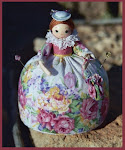
A display in one of the Delectable Mountain windows, these enchanting porcelain dolls:


Delectable Mountain business card:


Our parents, Lulu and Arthur, were married in Brattleboro in July, 1941, at the 'House of Flowers Tourist Home.'  I don't remember why they went to Brattleboro, as they lived and worked in Hartford.  Probably there were a lot of elopements during World War II.  Even though their wedding predates the war, people knew a war was coming.  When Arthur graduated from Trinity College in Hartford, Lulu remembered the speaker telling the graduates they would all be in uniform within a year. 


Lulu told me the evening they eloped she was waiting for Arthur in front of her office building.  A friend stopped by and asked if she wanted to go out for a drink, to which she replied she couldn't as she had a date with Arthur.  So secretive!  After they returned to Hartford Lulu continued to live with her sisters until an apartment could be found.  Her sister, Marie, saw the wedding announcement in the newspaper!

This amazing 'House of Flowers' is still on Main Street in Brattleboro!  Though the building looks in great condition, sadly, store fronts have been added and extend the front of the building to the sidewalk.  Eeek, I think one of them is a sub shop!  Carolyn and I wanted to find out more about the house, so we went across the street to the public library (old library photo below; the current library is newer).  In the local history section we looked through a couple of notebooks and found several pages relating to the house.  It was built by George Dowley in the late 1880's.  Mr. Dowley was president of the Vermont National Bank. 

The building, over the years, had many owners and tenants (Mr. and Mrs. Dowley had no children), including, naturally, a florist shop, Western Union offices, New Method Dry Cleaning, law offices, etc., and from 1937 to 1947, the 'House of Flowers Tourist Home.'  Presumably the hosts of the tourist home, Carl and Mary Hopkins, were also JP's and married many couples during the war years.  Lulu said that after she and Art were married their wedding dinner consisted of hamburgers at a local bar in town!


Brattleboro has several antique shops, and new and used book shops!  Carolyn and I sometimes race each other to the knitting and needlwork sections of used book stores!  Here is a charming book I found at one of the shops:


The Tasha Tudor Museum is in West Brattleboro, just a few miles from downtown.  There was a wonderful exhibit there of several dresses that were collected and / or made by Tasha Tudor.  They were beautiful examples of the mid 19th century style of dress that she loved to wear.  The museum is small, and the curator was on hand to give us a personal tour of the museum and costume exhibit.  Membership in the museum includes a lovely, color newsletter published two times a year.


One of the wall panels on our floor at the Latchis Hotel.  Please note the shiny spots, presumably made by a juvenile male staying at the hotel! 


Want more information about Brattleboro?  Click here.